On-site AI transcription and translation platform
Platform overview
This is a version of the Enterprise platform that focuses on providing real-time transcription and translation for on-site use during events. This manual describes how to use it. If you need a platform that also supports live and VoD video streaming, see our Enterprise Platform manual instead.
The main differences with our live video streaming solutions are:
- This platform only provides text transcription and/or audio translations. If you want to combine this with video streaming, you will need the Enterprise version.
- This platform focuses on AI speech-to-text conversion in real time. Our live video streaming solution uses latency to improve the speech-to-text conversion, by providing extra context.
This overview describes the top-level menus and briefly explains the terminology used in Clevercast.
The Dashboard page
The platform itself is only accessible to admin users with valid login credentials. After logging in, a user is directed to the dashboard. The contents of the dashboard depend on your plan and permissions.
The dashboard panels contain links, allowing you to go directly to a specific menu and page. On top of the page are the top-level menus, which allow you to navigate through the platform.
The Live menu
The Live menu and its Events submenu contain the main functionality of this platform. It lets you create and manage live streams of AI transcription and translation for on-site organizers and participants. Unless specified otherwise in your plan, your account allows for one simultaneous live stream. This means that you cannot broadcast to two events at the same time.
The Account menus
This contains the following sub-menus:
- Overview: contains information about your plan, the resources usage of your account (like live processing hours) and daily data traffic
- Settings: lets you determine the general behaviour of your account and allows creating FTP hotfolders
- Users: allows you to create and manage users and assign roles to them. Users log in with their email address and password. If the user's role includes the ‘Change Password’ permission, a user is allowed to change her own password.
- AI Vocabularies: lets you to create and manage account-level vocabularies. Their only purpose is to store vocabulary terms and metadata, so you can reuse them in multiple events.
Live Events
Before you start
A live event always has a certain status, which determines if you can start broadcasting and whether the transcriptions and translations are available to on-site participants. The appearance tab lets you set a separate image (or message) for each status, or a single general image for all statuses.
The event status can be:
- Inactive: While the event status is
Inactive, it is not ready to receive a broadcast. - Preview: After setting the status to
Preview, you can start broadcasting. When a broadcast is incoming, users in Clevercast can see and/or hear the transcription/translations. This also goes for the on-site production team. On-site participants, however, will not have access. They will see the Preview image/message. - Started: When you press the ‘Start event‘ button, the on-site application detects this and also makes the transcription/translations available to on-site participants (the Preview image/message automatically disappears).
- Paused: When you set the event status to
Paused, Clevercast keeps processing the incoming stream but hides it from on-site participants. The on-site application automatically detects the status change and shows the Paused image/message. The transcription/translations remain available in Clevercast and to the on-site production team. - Ended: When you set the event status to
Ended, Clevercast stops processing the live stream. The on-site application detects the status change and shows the Ended image/message.
The real-time management room in Clevercast is only available when the event status is set to Preview, Paused or Started. When the status is set to Inactive or Ended it is not possible to connect to the room.
Note that an event with AI-generated captions or speech currently has a maximum duration of 24 consecutive hours. If your event spans multiple days, set the event to Inactive or Ended during breaks and reset it again.
Creating a live event
To create a new live event, use the 'Live > Events' menu to go to the events overview page, and press the 'Create AI Multilingual Event' button.
The Event page
The event page consists of a number of tabs, which allow you to manage the different aspect of a live stream. Which tabs and settings are available depends on the broadcast protocol and the features of your plan.
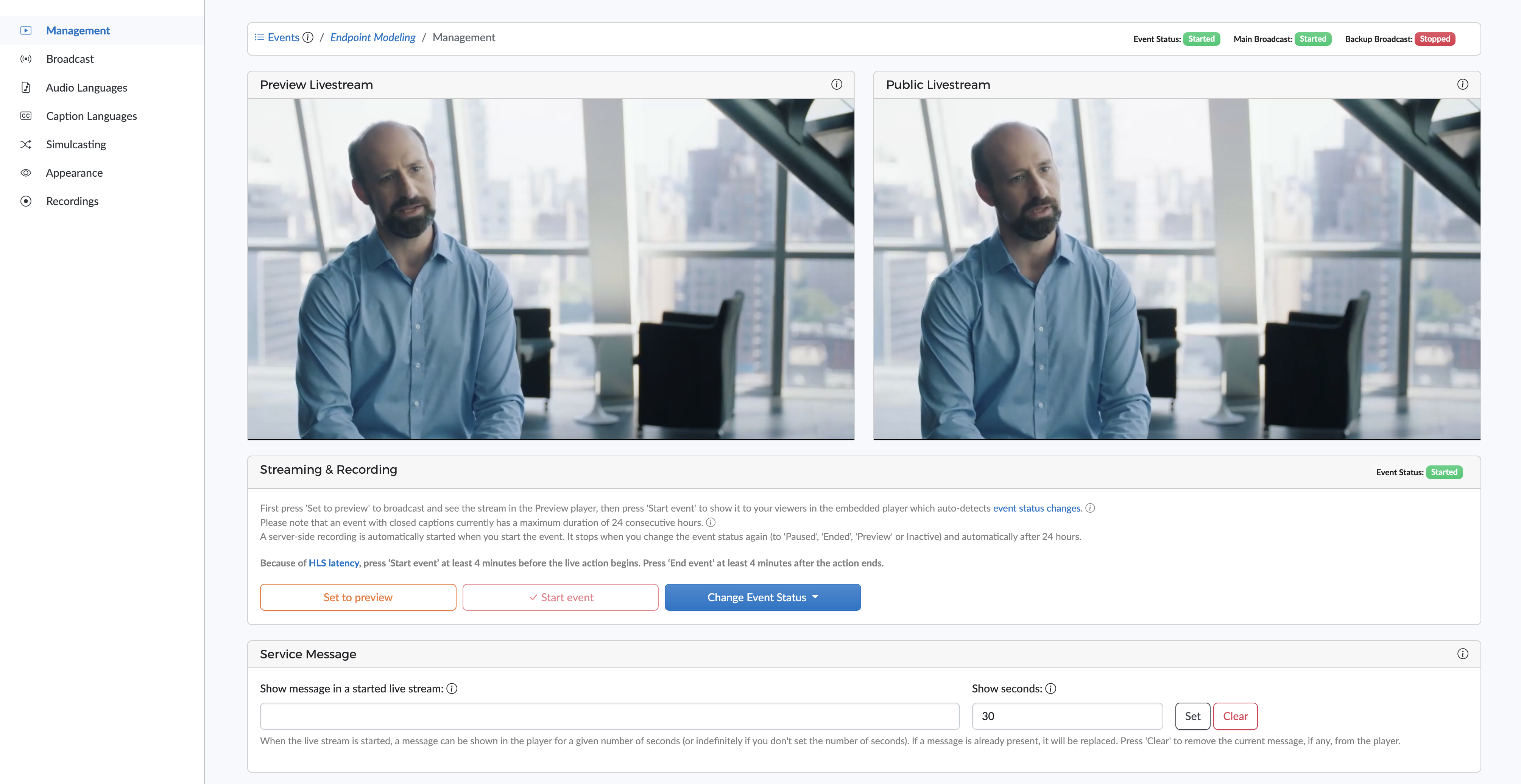
All tabs display the current event status and the main and backup broadcast statuses. When a broadcast is being received by Clevercast, this is set to Started.

Management
The Management tab lets you change the event status and go to real-time management room. It also contains the links to the application for the production team and on-site participants. An event also has a Name and Description, for your own information.
The Set to preview, Start event and Change Event Status buttons allow you to change the status of the event. Be aware that a status change may take some time.
Broadcast
The Broadcast tab contains the settings for your encoder or application to configure the broadcast to Clevercast.
For most broadcast protocols, Clevercast supports a fully redundant setup, which allows you to broadcast to a main and backup server on different geographical locations. Use the settings in the Backup Broadcast panel to send the same broadcast to both servers simultaneously. Clevercast player will detect if one of the streams is down and automatically failover to the backup stream, without your viewers having to refresh the page. This is also the case for the remote interpretation and captioning rooms.
For more info, see our guide on configuring your encoder or relay app.
Audio languages
The Default language
The 'Audio Languages' tab lets you set the default language, which refers to the main language spoken in your broadcast (also known as the floor language).
If the floor audio contains multiple languages, you can select Original instead of a real language. In that case, the application's first language will be called ‘Original’ and contain the broadcasted audio, no matter what language is spoken.
AI Speech languages
Clevercast lets you add simultaneous speech translations, generated by AI (also known as synthetic voices or AI dubbing).
For each language, Clevercast lets you choose a male or female voice. For certain languages (e.g. English, Spanish, Portuguese, French, Dutch) you can also choose a specific regional pronunciation (e.g. British, US, Australian or Indian English).
For more info, see the Audio languages section of our AI Live Streaming Manual.
Caption languages
This tab lets you manage the speech-to-text conversion and transcriptions. It also lets you add translated text transcriptions in different languages. The transcriptions have the form of a real-time scrolling transcript without delay. They can be projected on a screen by the production team, or shown on the devices of on-site participants.
The settings on this tab let you configure the language model, which is responsible for the speech-to-text conversion and text-to-text translation. Note that speech-to-text conversion is also needed if you only provide audio translations.
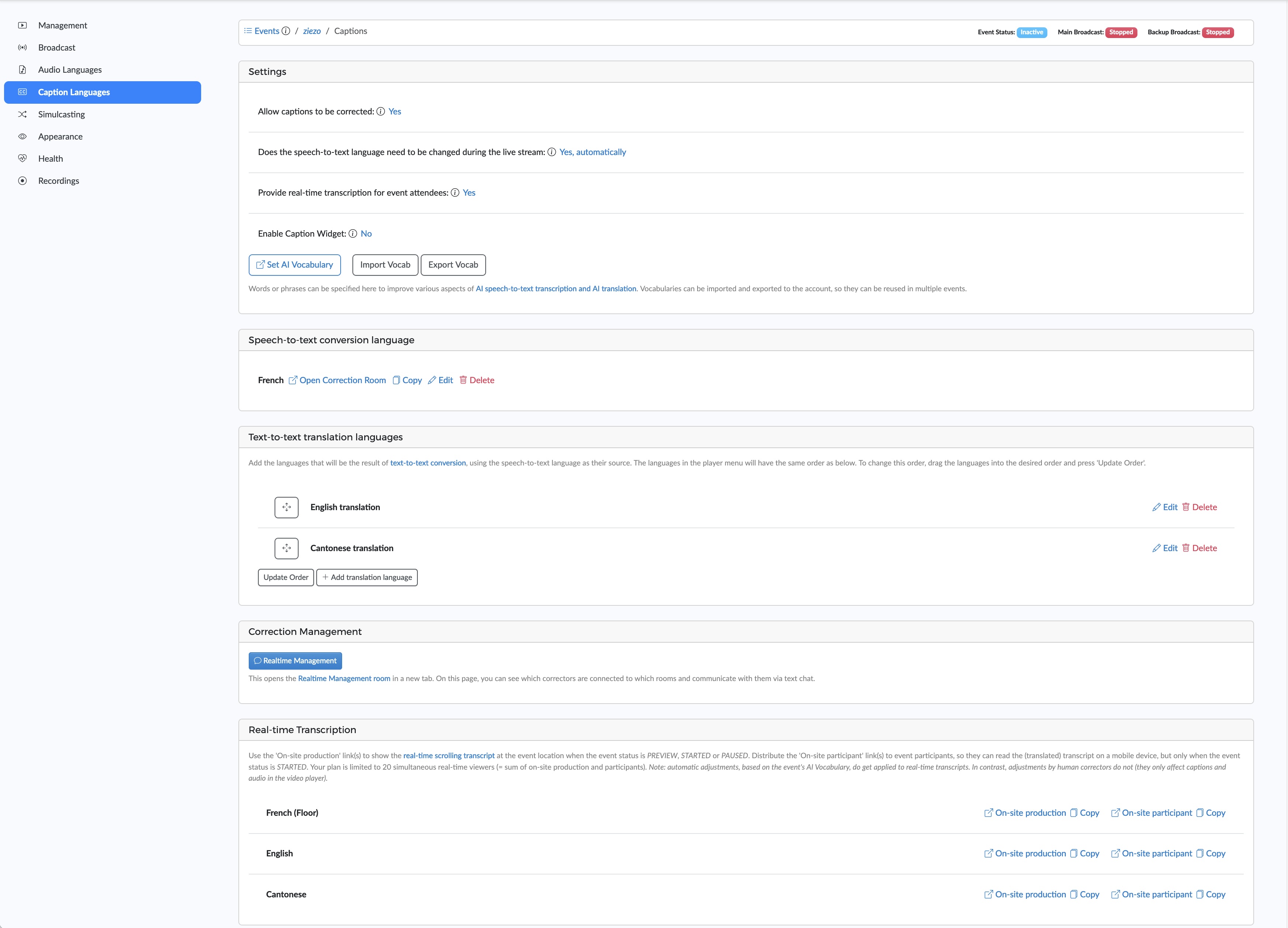
This tab also provides access to the AI vocabulary, which lets you define terms specific to your live stream. These are used by the language model to improve the speech-to-text conversion.
Appearance
The Appearance settings lets you set a separate image (or message) for each event status, or a single general image for all statuses.
- Images: images displayed in the on-site app when the event status is not
Started. You can set a separate image per status and/or a general image that will be displayed for each status without an image. - Messages: messages displayed in the on-site app when the event status is not
Started. A message will only be displayed if no image is available. If no image or message is set, Clevercast will display its default message for the status.
Health
The Health tab is only displayed when your broadcast uses RTMP or SRT, to give you feedback about the broadcast's health. If you use WebRTC (directly via your browser), the Health tab is not shown.
The information on this page indicates when Clevercast receives your broadcast. It includes warnings concerning the configuration of your encoder, an incorrect bitrate or frame rate, a choppy stream.... The messages on the health page can have three different levels:
- Info: these are messages for informational purposes. For example to indicate that an incoming stream is detected.
- Warning: these messages are displayed if your broadcast is not in line with our recommendations or best practices. By themselves, these are not major issues, but they may cause lower quality or give rise to other problems (e.g. a frame rate that is too high may cause not all frames to arrive in a timely manner).
- Error: these are issues that will give rise to a failing or faltering stream. They require you to take action.
Errors and warnings are also shown at the top of all other event tabs.
On-site application
The on-site app provides the real-time transcription(s) and/or translation(s). They can both be used by the production team, for display on a screen, and by event participants, to read the transcription and/or listen to the audio translations.
For each language there is a secure link on the event management page. As an event manager, you are responsible to distribute these links to the relevant participants.
When the event starts, participants only need to open these links in a browser with sufficient support for WebRTC (Chrome, Firefox, Safari, Edge) and press the play button. Participants will automatically see and/or hear the correct language. Note that the number of real-time participants is limited and their maximum number is determined by your plan.
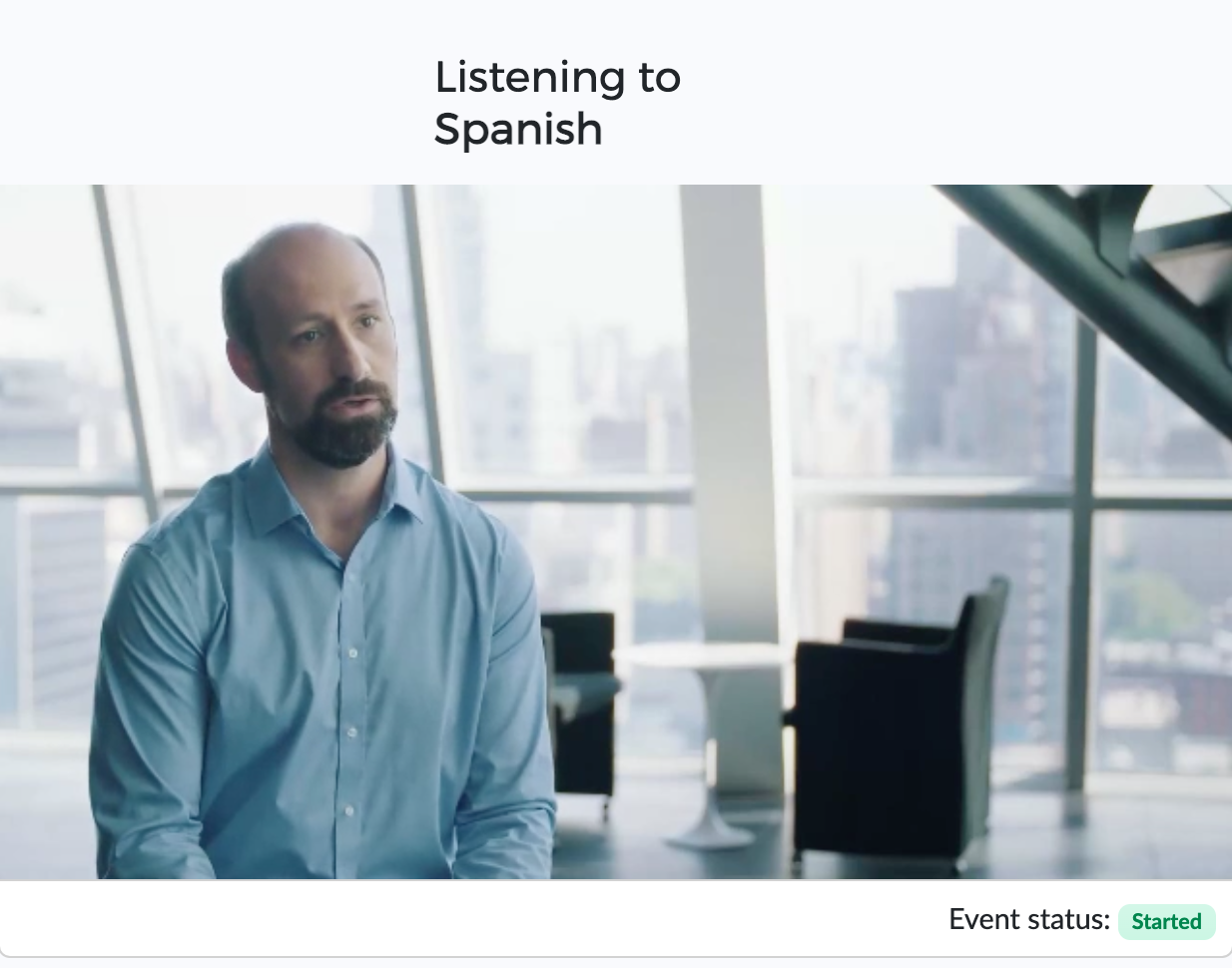
Note: in case of multilingual events, with the speech-to-text language being configured to change language, the on-site participants will hear nothing when the speaker is speaking their own language (so they can listen directly to the speaker).